Why GC-ERP Offers More Value and Flexibility
E‑commerce is evolving from standalone web storefronts toward integrated platforms that connect every part of a business. Shopify remains one of the most popular hosted platforms, but growing merchants often run into limitations: recurring subscription fees, add‑on costs, transaction fees, limited customisation and platform lock‑in networksolutions.com. In contrast, GC‑ERP (a locally‑built enterprise resource planning suite used by Sri Lankan retailers and manufacturers) combines e‑commerce, point‑of‑sale, inventory, accounting, CRM and manufacturing in a single system. This article explains why businesses that rely on Shopify should consider migrating to GC‑ERP.
Hidden Costs and Limitations of Shopify
Shopify’s appeal comes from its ease of use and drag‑and‑drop store builder, but there are several drawbacks that become apparent as sales grow:
- Recurring subscription and third‑party app costs — Shopify requires a monthly subscription and many essential features (advanced reports, multilanguage support, wholesale pricing, local payment gateways, etc.) must be purchased through third‑party apps. A 2025 review noted that users often complain about hidden costs: “many essential features require third‑party apps, which can quickly increase monthly expenses” networksolutions.com.
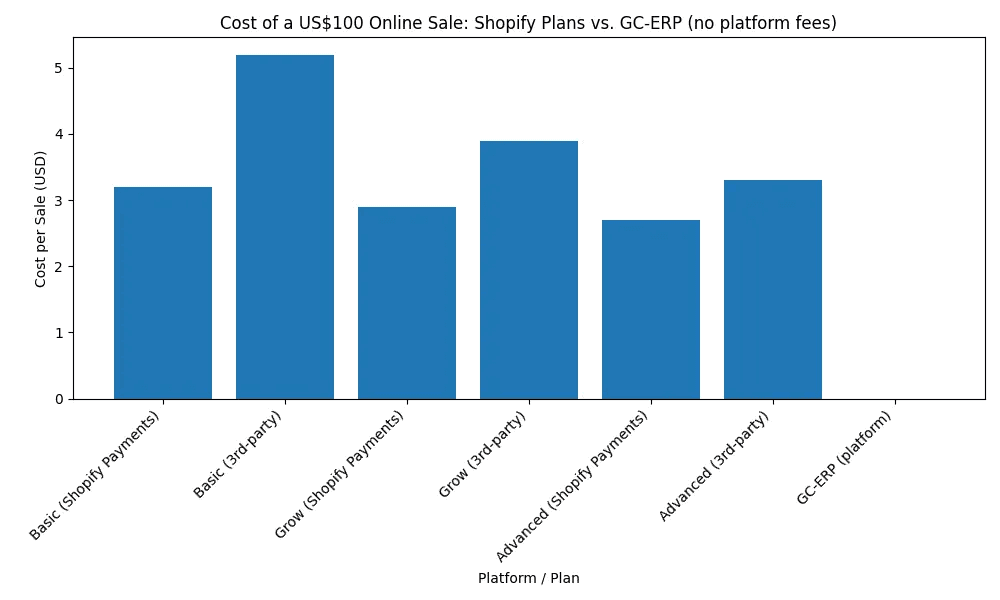
- Transaction fees — If merchants do not use Shopify Payments, they pay an extra transaction fee (up to 2 % on the Basic plan) plus the credit‑card processing fee. Shopify’s help center explains that the Basic, Grow and Advanced plans have different credit‑card rates and third‑party transaction fees help.shopify.com. On a US$100 sale, the total fee ranges from US$2.70 to US$5.20 depending on the plan and whether Shopify Payments is used networksolutions.com.
- Limited customisation and SEO control — Shopify restricts checkout customisation and URL structures, which can affect branding and search‑engine optimisation networksolutions.com. Advanced features often require apps that cannot fully modify core logic.
- Platform dependency — Because Shopify hosts the entire site, merchants are locked into its ecosystem. Migrating to another system is complex and data portability is limited networksolutions.com.
- Inconsistent support — The same review reports that users on lower‑tier plans experience long wait times and limited resolution options networksolutions.com. Phone and e‑mail support are typically reserved for Shopify Plus, leaving most merchants dependent on chat bots or forums.
What Do Shopify Fees Look Like in Practice?
The figure below compares the cost of a US$100 sale under different Shopify plans (using the credit-card rates cited above networksolutions.com) and assumes a card-not-present online transaction. It also includes a bar for GC-ERP, which does not charge any platform fee per sale (merchants only pay their local payment-gateway charges).
Benefits of Migrating to GC-ERP
Where Shopify relies on a network of third‑party apps, GC‑ERP delivers an integrated enterprise platform. Here are the core reasons why migrating makes sense for growing retailers and manufacturers:
- Flexible deployment & customisation — GC‑ERP can be deployed on our managed SaaS cloud or on your own servers or private cloud. This flexibility means you retain control of your data while enjoying the convenience of a managed solution. On‑premise ERP solutions can be customised to fit business needs perfectly and may cost less over time kohezion.com. GC‑ERP’s modular architecture lets you adapt modules, workflows and user interfaces to match fabric‑management processes, batch costing or multi‑store inventory rules — capabilities that are impossible on Shopify’s hosted platform networksolutions.com.
- All-in-one platform — GC‑ERP integrates point‑of‑sale, e‑commerce, inventory, CRM, accounting, manufacturing and warehouse management in a single system. Data flows seamlessly between modules, so stock levels are updated in real‑time across online and in‑store channels. With Shopify, merchants often purchase separate inventory, accounting and manufacturing apps, which increases complexity and cost.
- Transparent, usage-based pricing — GC‑ERP is offered as a SaaS platform with monthly or annual subscription fees tied to the number of system users and unique site visitors. There is a recurring subscription but no hidden transaction commissions — merchants only pay their local payment‑gateway charges. Shopify users often face unexpected costs because many essential features require paid apps and transactions fees networksolutions.com. but GC‑ERP pricing remains predictable and directly linked to actual usage.
- End-to-end migration & support — Our local team provides comprehensive onboarding and ongoing support. We help import your data from legacy systems, create product categories, variations, images and descriptions, and handle data entry until the site meets required standards. Subscription fees do not begin until the system goes live; only an initial project deposit is required. After go‑live, GC‑ERP continues to offer consultation and responsive support. In contrast, Shopify support is often limited on lower‑tier plans networksolutions.com.
- Local expertise & trust — Working with a local ERP partner offers personalised support and an understanding of regional business practices. A Liverpool‑based case study notes that a local ERP partner understands unique challenges, provides personalised support and ensures your ERP system aligns with business goals signum-solutions.co.uk. The same source emphasises ongoing local support, with proactive maintenance and quick issue resolution signum-solutions.co.uk. GC‑ERP is developed and supported in Sri Lanka, so clients benefit from on‑site training, faster response times and relationships built on trust.
- Data sovereignty & compliance — GC‑ERP lets you control where your data is stored and how it is backed up. Even when using our SaaS platform, data resides in Sri Lankan or regionally compliant data centres. This is important for companies that must comply with local tax and data‑protection laws. Shopify stores data in overseas data centres, which may raise compliance concerns.
- Scalability & performance — GC‑ERP can scale horizontally (by adding servers or containers) and vertically (by adding CPUs and memory). You are not constrained by Shopify’s rate limits or API quotas. Because GC‑ERP runs within your infrastructure or a private cloud, you can optimise performance for high traffic or large product catalogues (e.g., 30 k+ SKUs).
- Source code ownership & developer training — GC‑ERP provides clients with the Next.js e‑commerce storefront source code and full API documentation. Your in‑house developers can customise and extend the storefront without relying on third‑party vendors, and we provide training to ensure a smooth transition.
Conclusion
Shopify is an excellent platform for launching a simple online store quickly, but as your business grows the costs and limitations of the hosted model become more apparent: monthly subscriptions, hidden app expenses, transaction fees and limited customisation networksolutions.com networksolutions.com. GC‑ERP provides a scalable alternative: it integrates all business functions, offers flexible deployment (SaaS or self‑hosted) and lets you customise workflows to fit your unique processes kohezion.com. Pricing is tied to actual usage, with no hidden transaction commissions and no subscription fees until your site goes live. Local support teams ensure that problems are resolved quickly and that the system evolves with your business signum-solutions.co.uk signum-solutions.co.uk. For Sri Lankan businesses looking to control their data, comply with local regulations and build a truly omnichannel operation, migrating from Shopify to GC‑ERP is a strategic investment.
